
Hajj 2026: Saudi Arabia to Use Drones to Deliver Medicines at Holy Sites

Key Takeaways
- Saudi Arabia will deploy drones to transport medicines and medical samples at Masjid al-Haram (Grand Mosque), Masjid an-Nabawi (Prophet’s Mosque), and Hajj 2026 sites
- The drone system reduces ground delivery times of up to 90 minutes down to just six minutes
- The programme is backed by two years of trials and is part of Saudi Arabia’s Vision 2030 healthcare push
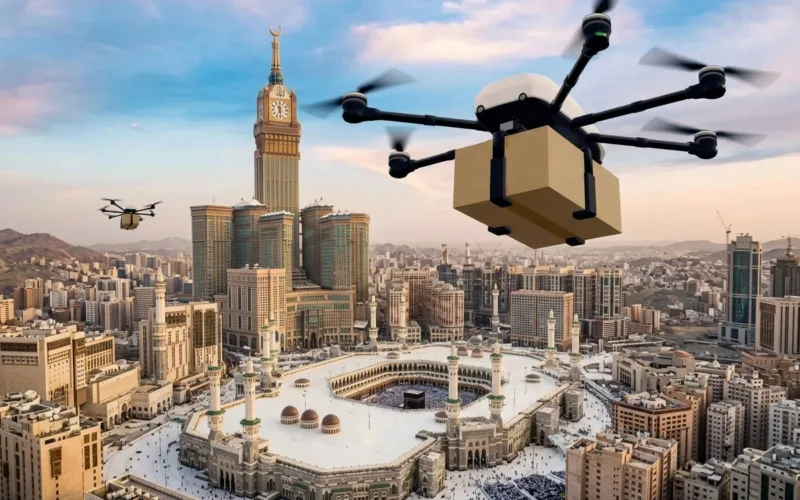
Saudi Arabia has put drones at the centre of its medical logistics plan for Hajj 2026, deploying the aircraft to carry medicines and medical samples across the holy sites — including Masjid al-Haram (Grand Mosque) in Makkah, Masjid an-Nabawi (Prophet’s Mosque) in Madinah, and the pilgrimage zones of Mina, Arafat, and Muzdalifah.
Two Years in the Making
Health Minister Fahad Al-Jalajel told Arab News the service is the result of two years of intensive studies and experiments, with trials covering safe takeoff and landing procedures as well as performance under high temperatures.
The drones are fitted with cooling systems to protect temperature-sensitive medical cargo.
“This modern technology aims to deliver medicines on a large scale during the Hajj season while reducing the time required to deliver medical supplies to just six minutes, compared to 90 minutes using ground transportation,” Al-Jalajel said.
How It Works
The project is a joint venture between the Makkah Health Cluster and the National Unified Procurement Company (NUPCO), which together manage the supply chain and logistics of essential medical resources across the region.
Deliveries are coordinated based on demand data from healthcare facilities, with shipments sent directly to hospitals and primary care centres inside the holy sites.
During the pilot phase carried out in Hajj 1446, one notable delivery saw ice packs sent by drone to Mina Emergency Hospital — supplies used to treat heat exhaustion and sunstroke, conditions commonly experienced by pilgrims during the peak summer heat.
Scale of Healthcare Deployment for Hajj 2026
The drone system sits within a wider healthcare operation being built for Hajj 2026. Minister Al-Jalajel confirmed that more than 20,000 hospital beds have been allocated for the season, including 3,800 within the holy sites, alongside 25 urgent care centres.
The ambulance fleet includes more than 3,000 vehicles and 11 air ambulances, supported by 7,700 paramedics and more than 52,000 health practitioners.
Saudi Arabia’s Ministry of Health described the deployment of drones to deliver urgent medical supplies as the first of its kind globally in managing healthcare for large-scale crowds.
With 1.5 million pilgrims expected from outside the Kingdom for Hajj 2026, the pressure on healthcare infrastructure at the holy sites makes rapid supply delivery essential.
Saudi Arabia has confirmed full 5G network coverage across the entirety of the holy sites for Hajj 2026, further supporting the connected systems that underpin the drone operation.


 WhatsApp Channel
 ChatGPT
 Instagram
 Facebook
 X (Twitter)
 Claude
 Ask Gemini AI
 Ask Grok AI
Support the officially authentic Islamic website.
Support our mission to spread Islamic knowledge. Your donation helps our volunteer writers and infrastructure. Contribute now.

