

Key Takeaways
- The Ramadan crescent cannot be sighted on Tuesday, February 17, due to the moon’s dangerously close position to the sun due to solar eclipse.
- Pointing telescopes or binoculars at the moon that evening risks direct exposure to sunlight, causing permanent eye damage.
- Sha’ban will likely complete 30 days, making Thursday, February 19, the first day of Ramadan for most of the region.
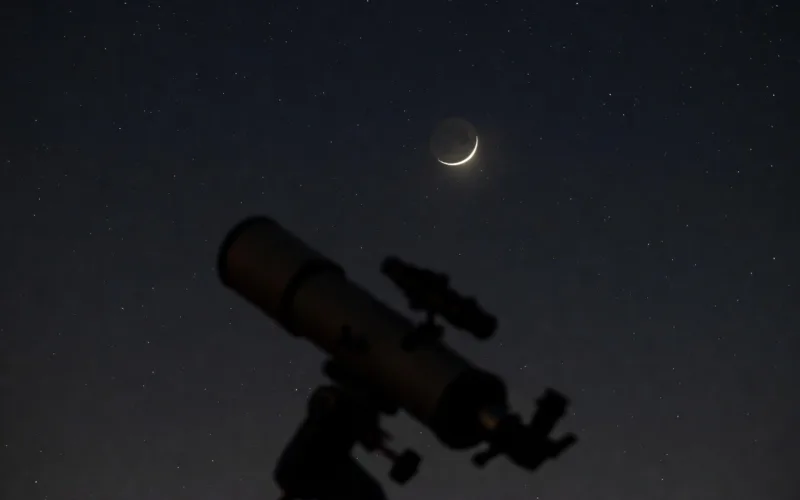
The International Astronomical Centre (IAC) has issued an urgent safety warning to observatories and the public ahead of the scheduled Ramadan crescent sighting for 1447 AH.
In a detailed statement released on Friday, the center strongly advised against any attempt to observe the moon using telescopes or binoculars on Tuesday, February 17, 2026, citing extreme proximity to the sun that makes sighting not only impossible but dangerously hazardous.
Permanent eye damage
According to the IAC, the angular separation between the sun and moon at sunset across much of the Arabian Peninsula will be minimal—just one degree in cities like Riyadh.
In practical terms, this places the thin crescent, if it existed, less than half a degree from the sun’s edge.
Directing a telescope or binoculars toward such proximity could inadvertently capture blinding sunlight, causing permanent eye damage and harming optical instruments.
The center emphasized that professional observatories strictly avoid pointing equipment at objects so close to the sun. By the time the sun fully sets, the lower edge of the moon’s disc would already have dipped below the horizon, leaving nothing visible to observe.
Solar eclipse
Astronomical data confirms the moon’s altitude at sunset will remain below recognized visibility thresholds across Saudi Arabia, with Jazan recording the highest elevation at around half a degree.
A partial solar eclipse occurring earlier that day—visible in parts of southern Africa and Antarctica—further confirms the moon remains in the new-moon phase rather than appearing as a visible crescent.
The IAC referenced classical Islamic scholarship, noting that medieval scholar Ibn Taymiyyah wrote that a crescent at a one-degree separation cannot be sighted. Modern astronomical standards align with this conclusion.
In parts of the western Arabian Peninsula, the moon may set about one minute after sunset, but astronomers confirm this brief gap is insufficient for visibility.
Most countries in the region are expected to attempt sighting on Tuesday evening. If the crescent is not seen—as all scientific evidence indicates—Sha’ban will complete 30 days, and Ramadan will begin on Thursday, February 19, 2026.
The IAC’s warning extends to amateur skywatchers: binoculars or unfiltered scopes pose the same risks. Officials urge the public to rely on official moon-sighting committee announcements and prioritize safety over futile attempts.


 WhatsApp Channel
 ChatGPT
 Instagram
 Facebook
 X (Twitter)
 Perplexity
 Ask Gemini AI
 Ask Grok AI
Support the officially authentic Islamic website.
Support our mission to spread Islamic knowledge. Your donation helps our volunteer writers and infrastructure. Contribute now.

