
Types of Janazah Announcements at the Two Holy Mosques


If you have ever prayed at Masjid al-Haram (Grand Mosque) in Makkah or Masjid an-Nabawi (Prophet’s Mosque) in Madinah, you have likely heard a short Arabic phrase called out after the fard prayer before the Janazah begins.
For many worshippers, it passes as background sound. But that phrase carries precise meaning — it tells the Janazah prayer exactly who they are about to pray for.
Four Phrases, Four Situations
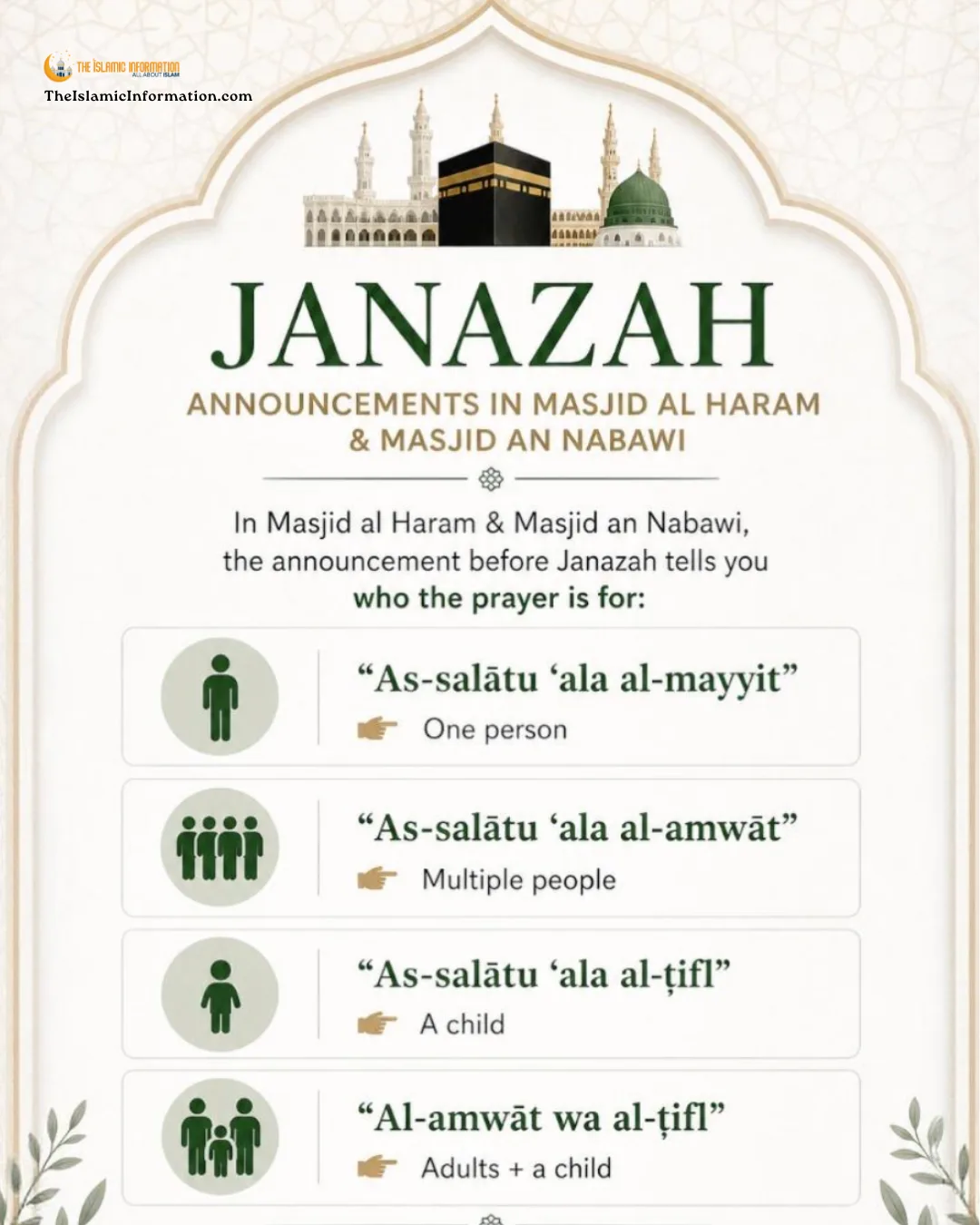
The announcement follows a clear system. Each phrase corresponds to a specific type of deceased:
- “As-salātu ‘ala al-mayyit” — This is used when there is one deceased adult. Al-mayyit is the Arabic singular for “the deceased.”
- “As-salātu ‘ala al-amwāt” — This is used when there are multiple deceased adults. Al-amwāt is the plural form.
- “As-salātu ‘ala al-ṭifl” — This is used when the deceased is a child. Al-ṭifl means “the child.”
- “Al-amwāt wa al-ṭifl” — This is used when there are both adults and a child to be prayed over at the same time.
Why It Matters
In Salat al-Janazah, every worshipper must form a clear intention before the prayer begins. Part of that intention involves knowing who the prayer is for.
The announcement removes any ambiguity — especially in the large congregations at the Two Holy Mosques, where the body is not always visible to those praying in distant rows.
At both Masjid al-Haram (Grand Mosque) and Masjid an-Nabawi (Prophet’s Mosque), Janazah prayer is offered after every fard prayer.
Making the distinction between al-mayyit, al-amwāt, and al-ṭifl practically important for worshippers forming their niyyah.


 WhatsApp Channel
 ChatGPT
 Instagram
 Facebook
 X (Twitter)
 Claude
 Ask Gemini AI
 Ask Grok AI
Support the officially authentic Islamic website.
Support our mission to spread Islamic knowledge. Your donation helps our volunteer writers and infrastructure. Contribute now.

