
Muslim Astronaut to Be First Foreigner on China’s Space Station

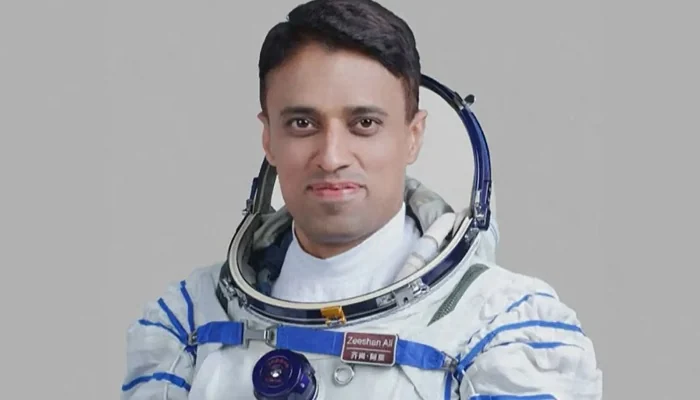
Muslim astronaut Muhammad Zeeshan Ali, Pakistan’s first astronaut, is due to fly to China’s Tiangong space station on Wednesday, November 25.
The Shenzhou-24 spacecraft will lift off at 8:18am Beijing time (5:18am Pakistan time) from the Jiuquan Satellite Launch Centre in north-western China.
The China Manned Space Agency (CMSA) gave the launch time at a pre-launch media briefing on Tuesday.
Who Is On the Shenzhou-24 Crew
Ali joins Chinese astronauts Tang Hongbo and Wu Yi as a payload specialist. He becomes the first Pakistani to travel to space and the first foreign astronaut to visit Tiangong.
Tang Hongbo will command the mission. He has flown on Shenzhou-12 and Shenzhou-17 and will become the first astronaut to visit Tiangong three times. Wu Yi, a member of China’s third batch of astronauts, will serve as flight engineer.
Muslim Astronauts Who Have Flown to Space Before
Ali follows Muslim astronauts from other countries who have already flown. Sultan bin Salman Al Saud was the first Muslim and the first Arab in space, in 1985.
| Astronaut | Nationality | Year |
|---|---|---|
| Sultan bin Salman Al Saud | Saudi Arabia | 1985 |
| Muhammed Faris | Syria | 1987 |
| Musa Manarov | Soviet Union (Azerbaijani) | 1987 |
| Abdul Ahad Mohmand | Afghanistan | 1988 |
| Toktar Aubakirov | Kazakhstan | 1991 |
| Talgat Musabayev | Kazakhstan | 1994 |
| Anousheh Ansari | United States (born in Iran) | 2006 |
| Sheikh Muszaphar Shukor | Malaysia | 2007 |
| Aidyn Aimbetov | Kazakhstan | 2015 |
| Hazza Al Mansouri | United Arab Emirates | 2019 |
| Sara Sabry | Egypt | 2022 |
| Rayyanah Barnawi | Saudi Arabia | 2023 |
| Ali Al-Qarni | Saudi Arabia | 2023 |
| Sultan Al Neyadi | United Arab Emirates | 2023 |
| Namira Salim | Pakistan | 2023 |
| Alper Gezeravcı | Turkey | 2024 |
Anousheh Ansari was the first Muslim woman in space. Sara Sabry and Namira Salim flew on short suborbital flights.
What Ali Will Do On Tiangong
Ali’s mission is short. According to the briefing, he will take part in routine crew activities, install experimental samples and research equipment, and carry out scheduled experiments on the orbiting laboratory.
His work builds on four Pakistani biotechnology experiments. Chinese institutions picked them from more than 300 proposals that universities across Pakistan sent to the Space and Upper Atmosphere Research Commission (SUPARCO). SUPARCO officials earlier told Reuters the experiments focus on food security and climate change.
SUPARCO said Ali will spend about one week on the station before returning to Earth aboard the Shenzhou-23 spacecraft.
How Ali Trained For the Mission
Chinese authorities strengthened Ali’s specialist training in spacecraft and space station operations, scientific experiment procedures and emergency response. The crew also ran joint exercises on operational coordination, procedure handovers and handling technical problems.
Ali learned Chinese commands and technical terms so he can communicate and carry out procedures accurately.
The Astronaut Centre of China also prepared Chinese-English operating manuals and halal space food to suit his language and dietary needs.
Chinese space programme reports say these arrangements were shown during the final full-system launch rehearsal at Jiuquan on November 21.
How the Pakistan-China Mission Came Together
Pakistan and China signed an agreement in February 2025 on selecting and training Pakistani astronauts for Chinese space station missions. That formally began the selection process.
After three rounds of screening and assessment, Ali and Khurram Dawood were chosen as reserve astronaut candidates and finished their training in China. Ali has now been picked for the flight, and Dawood will be his backup.
The mission is also the first joint crewed spaceflight involving Chinese and foreign astronauts in China’s human spaceflight history. It makes Tiangong the first Chinese space station to host a foreign astronaut.
Crew Rotation and Launch Readiness
Shenzhou-24 also changes the crew rotation on the Chinese station. Zhu Yangzhu, from the outgoing Shenzhou-23 crew, will stay on Tiangong for a year-long in-orbit residency experiment.
The spacecraft and its Long March-2F rocket were moved to the launch area on November 17. The final full-system rehearsal was completed four days later.
At Tuesday’s briefing, Chinese authorities said the spacecraft and rocket were in controlled condition, the crew was in good shape, and the space station complex was running normally.
The flight is expected to open new paths for Pakistan in human spaceflight, scientific experiments and international space cooperation.


 WhatsApp Channel
 ChatGPT
 Instagram
 Facebook
 X (Twitter)
 Claude
 Ask Gemini AI
 Ask Grok AI
Support the officially authentic Islamic website.
Support our mission to spread Islamic knowledge. Your donation helps our volunteer writers and infrastructure. Contribute now.

