
Australia’s Halal Pharmaceutical and Cosmetics Industries Outpace Global Growth, New Report Finds


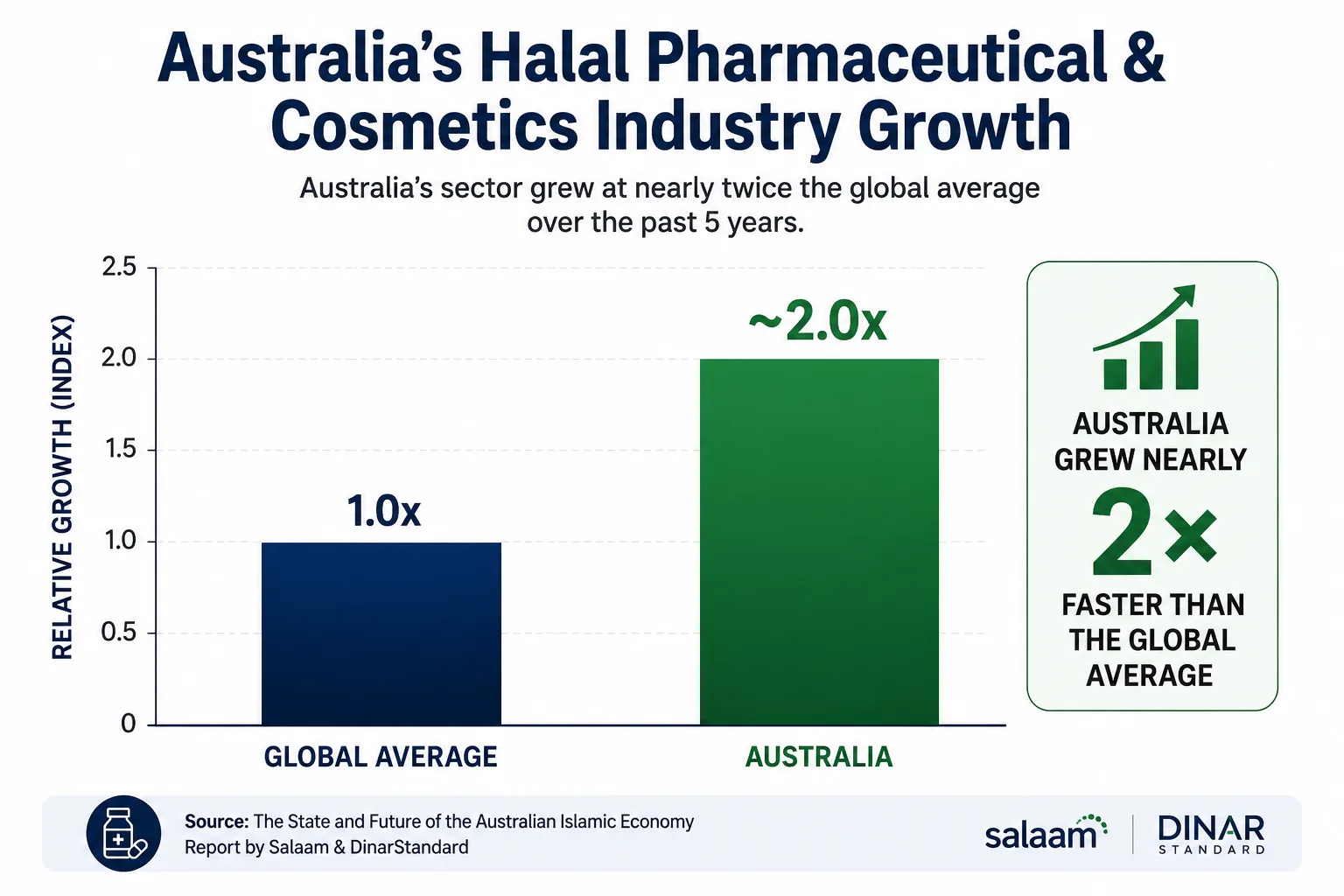
SYDNEY — Australia’s halal pharmaceutical and cosmetics sectors have expanded at nearly twice the global average growth rate over the past five years, positioning the country as an increasingly important player in the global Islamic economy, according to a newly released industry report.
The findings come from The State and Future of the Australian Islamic Economy, a report published by Salaam in collaboration with DinarStandard. The study highlights Australia’s transition from being primarily known for halal food exports to developing a broader Islamic economy that includes pharmaceuticals, nutraceuticals, cosmetics, finance, technology, tourism, and education.
While halal food remains Australia’s largest Islamic economy segment, the report identifies pharmaceuticals, health supplements, and cosmetics as some of the country’s fastest-growing halal industries. Researchers say these sectors are strengthening Australia’s position in international markets while creating new opportunities for investment and exports.
Dean Gillespie, Chief Executive Officer of the Islamic Finance and Investment Association, said Australia’s Islamic economy has become an increasingly significant contributor to both domestic business activity and international trade.
Although Australia’s halal economy is projected to exceed A$10 billion, it represents only a small share of the estimated US$5 trillion global Islamic economy. However, the report notes that several Australian halal industries are growing faster than global averages, driven by rising demand for products associated with ethical sourcing, transparency, sustainability, and high manufacturing standards.
Industry experts believe Australia is well placed to benefit from this trend due to its internationally recognised regulatory framework, advanced manufacturing capabilities, strong product traceability, and established research sector. These advantages have helped Australian manufacturers expand exports to major Muslim consumer markets across Southeast Asia and the Middle East.
The report highlights vitamin and supplement manufacturers as key contributors to the sector’s growth. Australian companies have increasingly secured internationally recognised halal certifications, allowing them to access high-growth overseas markets while meeting strict quality and compliance standards.
Australia’s manufacturing reputation has also attracted overseas companies seeking reliable production facilities for halal-certified pharmaceuticals, nutraceuticals, and wellness products. Analysts say this could strengthen Australia’s role as a regional manufacturing hub for halal health and wellness products.
Growth is also accelerating in the cosmetics industry, where halal-certified skincare and personal care products are attracting a wider consumer base. Beyond meeting religious requirements, many shoppers now associate halal certification with product quality, ethical sourcing, ingredient transparency, and responsible manufacturing practices.
The report suggests that halal certification is increasingly viewed as a broader mark of trust rather than solely a religious standard, helping halal-certified products gain acceptance among mainstream consumers.
Researchers argue that Australian businesses should treat halal certification as a long-term strategic advantage instead of simply a regulatory requirement. By integrating halal standards into broader business strategies focused on innovation, sustainability, and international competitiveness, companies could unlock additional export opportunities and attract greater investment.
However, the report also warns that Australia risks losing momentum unless it addresses ongoing challenges within its halal certification system. Multiple certifying bodies, inconsistent standards, and limited regulatory coordination continue to create complexity for manufacturers and uncertainty for overseas buyers.
According to the report, establishing a more consistent and internationally recognised halal certification framework would improve Australia’s competitiveness, reduce administrative burdens for exporters, and strengthen confidence among global trading partners.
Researchers conclude that Australia’s halal pharmaceutical and cosmetics industries have demonstrated strong international potential, but future growth will depend on coordinated industry standards, stronger policy support, and a unified certification system capable of reinforcing Australia’s reputation as a trusted global supplier of halal products and services.


 WhatsApp Channel
 ChatGPT
 Instagram
 Facebook
 X (Twitter)
 Claude
 Ask Gemini AI
 Ask Grok AI
Support the officially authentic Islamic website.
Support our mission to spread Islamic knowledge. Your donation helps our volunteer writers and infrastructure. Contribute now.

