
Islamic Inheritance Calculator
Calculate Islamic inheritance shares according to the Holy Quran and Sunnah. Free Faraid calculator with step-by-step breakdown and Quranic verse references for each legal heir.
The Deceased
Select the gender of the deceased family member.
Estate Value & Liabilities
Debts, funeral costs, and valid bequests must be settled before distributing inheritance.
Surviving Legal Heirs
Select which eligible family members survived the deceased and their count.
Inheritance Breakdown & Distribution
| Legal Heir | Quranic Basis | Share (%) | Total Amount | Each Heir | Quranic Reference |
|---|
Understanding Islamic Inheritance (Faraid)
Faraid (Arabic: علم الفرائض) is the science of Islamic inheritance jurisprudence. It is one of the most rigorously detailed branches of Islamic law, with specific fractional allotments directly ordained by Allah in the Holy Quran.
The Prophet Muhammad (peace be upon him) highlighted its sanctity, stating:
“Learn the Quran and teach it to the people, and learn the science of inheritance (Faraid) and teach it to the people, for I am a mortal and knowledge will be taken away.”
— Sunan al-Tirmidhi (2091)
The 4 Essential Stages of Islamic Estate Administration
Before distributing any inheritance to heirs under Islamic law, the estate must undergo four mandatory stages of settlement in strict sequential order:
- Tajheez & Takfeen (Funeral & Burial Costs): Reasonable expenses for washing, shrouding, and burying the deceased must be paid first.
- Duyoon (Settlement of All Debts): All debts owed by the deceased to individuals, institutions, or Allah (such as unpaid Zakat or Kaffarah) must be satisfied in full from the estate before any inheritance is distributed.
- Wasiyyah (Execution of Bequests): Valid wills and charitable bequests are executed next. Under authentic Hadith (Sahih al-Bukhari 2742), bequests are strictly limited to a maximum of one-third (1/3) of the net estate and cannot be made in favor of a legal Quranic heir.
- Tarkeeb al-Tarkah (Faraid Distribution): The entire remaining net estate is divided among the eligible surviving heirs according to the fractional shares decreed in the Quran.
The Two Categories of Legal Heirs
Islamic law classifies heirs into two primary groups:
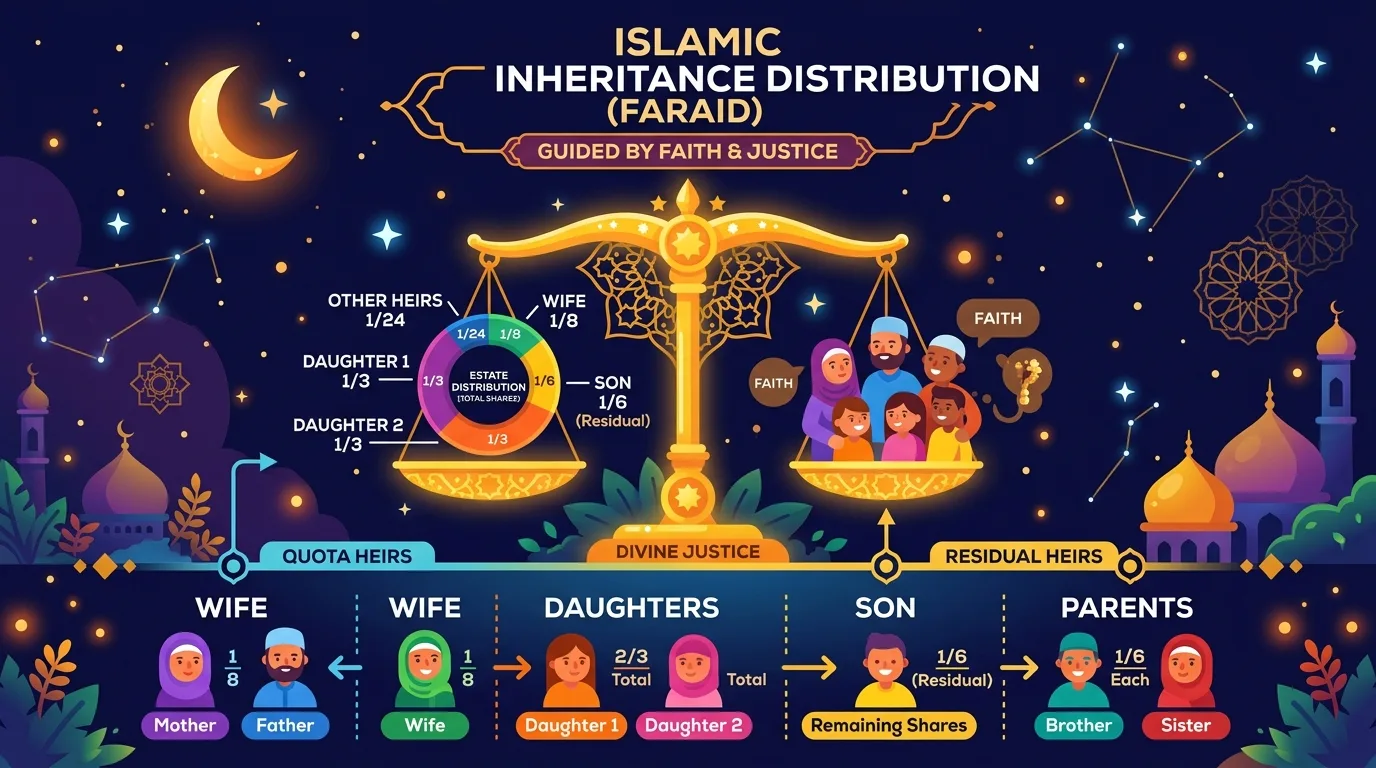
- Ashab al-Furud (Fixed-Share Quranic Heirs): Twelve legal heirs who receive an explicit Quranic fraction (1/2, 1/4, 1/8, 2/3, 1/3, or 1/6). These include the spouse, mother, father, daughters, and sisters.
- Asaba (Residuary Heirs): Relatives who receive the entire remaining balance of the estate after fixed shares have been satisfied. Primary Asaba include sons, father (when no male descendants exist), and brothers. When sons and daughters inherit together, sons receive twice the share of daughters (Quran 4:11).
Special Jurisprudential Cases: Awl and Radd
Real-world inheritance calculations frequently encounter scenarios where fractions do not equal exactly 100%:
- Awl (العول – Proportional Share Reduction): When the sum of prescribed Quranic shares exceeds 1 (for example, Husband 1/2 + 2 Daughters 2/3 = 7/6 or 116.7%), the common denominator is raised, proportionally reducing every heir’s allotment without depriving anyone. This legal doctrine was established by Caliph Umar ibn al-Khattab with the unanimous agreement of the Sahaba.
- Radd (الرد – Surplus Redistribution): When the sum of fixed shares is less than 1 and there is no residuary (Asaba) heir to take the remainder, the leftover estate is returned and redistributed among the blood-relative Quranic heirs in proportion to their initial shares.


 WhatsApp Channel
 ChatGPT
 Instagram
 Facebook
 X (Twitter)
 Claude
 Ask Gemini AI
 Ask Grok AI
Support the officially authentic Islamic website.
Support our mission to spread Islamic knowledge. Your donation helps our volunteer writers and infrastructure. Contribute now.
